MasterSearch

Showing posts with label Dollar. Show all posts

Thursday, March 05, 2020

#Dollar-#Euro has had a wild ride in the last month...


Share
_______________________________________
Check it out on The MasterCharts

Monday, October 10, 2011

Gold Price Set to Drop into Aggressive Accumulation Zone

Gold Price Set to Drop into Aggressive Accumulation Zone

Commodities / Gold and Silver 2011 Oct 09, 2011 - 09:30 AM
It now looks like we were a little too bullish in the last update, for the way gold has acted over the past week suggests that another sharp drop is imminent before the dust finally settles on this reactive phase, that it likely to take it to or some way below its recent panic lows.
On gold's 4-month chart it is now apparent that a bear Pennant has been forming since the panic bottom, with the weak upside volume portending an imminent breakdown and steep drop. A reader pointed out to me during last week that gold's panic lows occurred in thin trading on the Hong Kong market, and for this reason we do not have to factor in the tail of the hammer candlestick when deciding where to draw the boundaries of the Pennant. The measuring implications of this Pennant call for a drop at least to the vicinity of the intraday lows of the Reversal Hammer and possibly somewhat lower towards the $1520 area - at this point the decline should have completely run its course and we will be looking to buy aggressively. If we look carefully we can see that a small "bearish engulfing pattern" has formed in gold over the past 2 trading days, implying that breakdown from the Pennant and the expected steep drop that will follow is imminent. A reason why this next drop should end the decline is that gold is already deeply oversold as shown by its MACD indicator, and it will of course be even more so after this impending decline. Those interested in going long gold investments in the near future should "keep their powder dry" but stand ready to wade in big time if gold drops into the bright green "aggressive accumulation zone" shown on our chart.


Other reasons why the imminent sharp drop expected should mark the end of gold's reactive phase are to be seen on its 1-year chart. On this chart we can see that a decline to or below its recent panic lows will take it deep into strong support near to its rising 200-day moving average, the classic point for a major reaction in an ongoing bullmarket to end.


Still another reason for the reaction to terminate with this final drop are gold's now strongly bullish COT chart on which we can see that Commercial short and Large Spec long positions have dropped back to relatively low levels - the lowest for a long, long time.


There is certainly plenty of light at the end of the tunnel for gold over a longer time horizon, and not just that which arises from its own COT charts. The COT charts for the dollar are strongly bearish, with the Commercials going heavily short, and they are also going heavily long the euro. This implies that the current state of extreme crisis in the Eurozone should ease soon and the euro rally sharply, and the dollar fall heavily - which suggests that european leaders may scale back their bickering soon and cooperate sufficiently to ease the crisis with generous helpings of QE, which will of course be bullish for gold and silver. Our euro fx COT chart below shows the big long position in the that the Commercials have built up.


Although the big Commercial short position in the dollar is a harbinger of doom for the current strong dollar rally, it looks on its 3-month chart like it has a bit of life left in it yet. The long-legged doji candlestick that formed on Friday implies that it will turn higher again next week and maybe make new highs.


Bearish price action in both copper and oil on Friday suggests that they too will turn down this coming week.
By Clive Maund
CliveMaund.com
For billing & subscription questions: subscriptions@clivemaund.com
© 2011 Clive Maund - The above represents the opinion and analysis of Mr. Maund, based on data available to him, at the time of writing. Mr. Maunds opinions are his own, and are not a recommendation or an offer to buy or sell securities. No responsibility can be accepted for losses that may result as a consequence of trading on the basis of this analysis.
Mr. Maund is an independent analyst who receives no compensation of any kind from any groups, individuals or corporations mentioned in his reports. As trading and investing in any financial markets may involve serious risk of loss, Mr. Maund recommends that you consult with a qualified investment advisor, one licensed by appropriate regulatory agencies in your legal jurisdiction and do your own due diligence and research when making any kind of a transaction with financial ramifications.
Clive Maund Archive

© 2005-2011 http://www.MarketOracle.co.uk - The Market Oracle is a FREE Daily Financial Markets Analysis & Forecasting online publication.
Gold Price Set to Drop into Aggressive Accumulation Zone :: The Market Oracle :: Financial Markets Analysis & Forecasting Free Website

The MasterMetals Blog

Friday, September 09, 2011

Global Currency Wars Sees Swiss Franc Devalue 8.5% Against Gold In Week | ZeroHedge

Gold in Swiss Francs

Gold in Swiss Francs – 5 Day (Tick)


Gold in Swiss Francs in Nominal Terms – 40 Years (Quarterly)
From zerohedge.com:
The Swiss franc’s 10% plummet against gold this week clearly shows how cash is far from ‘king’ and no fiat currency in the world, in any bank in the world can be considered a “safe haven”.
Gold is again becoming the sovereign of sovereigns and reasserting itself as the safe haven money and asset par excellence.
If the Swiss franc, long considered the safest fiat currency in the world, can devalue 10% in a week, then it can happen and likely will happen to other currencies as well.


Global Currency Wars Sees Swiss Franc Devalue 8.5% Against Gold In Week | ZeroHedge


Share
_______________________________________
Check it out on The MasterCharts

Monday, March 21, 2011

Silver: China Imports 245T In Feb, Qatar SWF “Interested” In Buying

China Imports 245 Tonnes of Silver in February and Qatar SWF "Interested" in Buying Silver

Date: March 21, 2011


Gold and silver rose on the open in Asia and have continued those gains so far in European trading with the Libyan military conflict leading to a safe haven bid and falls in the dollar and yen. The all time and multiyear nominal dollar highs set on March 7th ($1,444.95/oz and $36.75/oz) look set to be challenged as gold is less than 1% from its record high and silver less than 2% from its nominal recent high.

Safe haven demand continues especially in Asia and macroeconomic and geopolitical risk remains elevated. The tragedy in Japan and possibility of an ecological catastrophe has clouded the economic picture and created even more uncertainty which will lead to continuing physical demand.

In Japan, many ATMs have not been working for days now and this is leading to safe haven demand for gold. Should efforts to sort out the ATM problem not be resolved this week it could out pressure on the already strained Japanese financial system.

Iran and Other Central Banks Secretly Increasing Gold Reserves

News that Iran and other nations with large dollar currency reserves have greatly increased their gold reserves (see News) will not come as a surprise to our readers. It stands to reason that they would given the degree of exposure which most creditor nations have to the U.S. dollar. It also stands to reason as some of them do not have cordial relations with Washington and may be reluctant to fund the U.S. continuing imprudent fiscal policies.

Gold was not the only precious metal being bought with the FT reporting that the sovereign wealth fund of Qatar, the Qatar Investment Authority is reportedly interested in acquiring both and gold and silver.

The QIA has assets estimated to exceed $65 billion and this one sovereign wealth fund alone could easily corner the very small physical silver market which is worth some $36 billion at today's prices (1 billion ounces of above ground, investment grade refined silver bullion multiply by $36 per ounce).

China Imports 245 Tonnes of Silver in February and Qatar SWF "Interested" in Buying Silver
Central banks and sovereign wealth funds with massive exposure to the dollar, such as the Russians and Chinese, are not going to shout from the roof tops their intentions to diversify into gold and silver bullion as this would lead to a surge in bullion prices and an even greater depreciation of their dollar holdings.

China imported 245.6 metric tons of silver in February. The figure is close to the 260.6 metric tons imported in February 2010 and suggests that the Chinese are more than willing to buy silver at over $30 per ounce. It also suggests that the record Chinese imports of 3,475,394 kilos seen in 2010 (a massive four fold increase from 2009) may be again attained in 2011.

This demand is likely from the private sector rather than official but it is quite possible that there has been official buying in recent months. This may have come from the Chinese State Administration of Foreign Exchange (SAFE) which manages nearly $3 trillion of currency reserves. The Chinese has experienced the collapse of a paper currency and hyperinflation as recently as 1949 and therefore appreciate the value of gold (and silver) as currencies which cannot be debased.

NEWS

(Financial Times) -- Iran bought gold to cut dollar exposure

Iran has bought large amounts of gold in the international market, according to a senior Bank of England official, in a sign of how growing political pressure has driven Tehran to reduce its exposure to the US dollar.

Andrew Bailey, head of banking at the Bank of England, told an American official that the central bank had observed "significant moves by Iran to purchase gold", according to a US diplomatic cable obtained by WikiLeaks and seen by the Financial Times.
Mr Bailey said the gold buying "was an attempt by Iran to protect its reserves from risk of seizure".
Market observers believe Tehran has been one of the biggest buyers of bullion over the past decade after China, Russia and India, and is among the 20 largest holders of gold reserves.
They estimate it holds more than 300 tonnes of gold, up from 168.4 tonnes in 1996, the date of the most recent International Monetary Fund data.
The cable, dated June 2006, is the first official confirmation of Tehran's buying.
Last year central banks became net buyers of bullion after 22 years of large sales, helping drive gold prices to all-time nominal highs. Trades by central banks are often kept secret.
Bankers said other Middle Eastern countries had also been quietly adding to gold holdings to diversify away from the dollar amid political tensions and volatility in currency markets.
"The totality of central bank reserves is not what is reported to the IMF," said Philip Klapwijk, executive chairman of GFMS, a precious metals consultancy. "There's probably another 10 per cent on top of that."
Cables obtained by WikiLeaks cite Jordan's prime minister as saying the central bank was "instructed to increase its holdings" of gold, and a Qatar Investment Authority official as saying the QIA was interested in buying gold and silver.
"There is no question some Middle Eastern countries are very interested in buying gold," said George Milling-Stanley, head of government affairs at the mining industry-backed World Gold Council.
In the past two months, the political unrest in the Middle East has helped propel gold to a record price of $1,444.40 a troy ounce.
The Bank of England declined to comment on the cables, but did not dispute their contents. The central banks of Iran and Jordan and the QIA did not respond to requests for comment.QIA did not respond to requests for comment.

Thursday, March 17, 2011

The Day The Yen Carry Trade Died | zero hedge

The Day The Yen Carry Trade Died | zero hedge


It's gotta hurt real bad now!!!


While everyone is staring in disbelief at the USDJPY, the real carry action is in the high yielding-YEN pairs, i.e., the development, high growing countries. And it's a massacre: ZARJPY, NZDJPY, AUDJPY - all are plunging far more than the USD. This is nothing short of a complete carry trade unwind. The implications: the cheapest recurring source of funding for risk assets - the Yen carry trade, is over. Those who managed to sell early on are lucky. The rest will get such an onslaught of margin calls tomorrow they may need to access the discount window (if Primary Dealers and the luckier banks). Many will be forced to sell assets to satisfy collateral requirements as ongoing sales of carry pairs push the Yen ever higher, and force ever more liquidity out of the market. And if the Yen carry trade is done, the question is when will the USD, which has also been a carry currency for some time, follow suit. And, once again, the most troubling observation is that the BOJ has not intervened. Our sinking feeling is that after pumping 50 trillion or so in money markets, the petty cash may be running quite low. In any case, ES opens in 2 minutes. Grab the popcorn now.


The Day The Yen Carry Trade Died | zero hedge

Share
_______________________________________
Check it out on The MasterCharts

USDJPY Goes Bidless

USDJPY Goes Bidless | zero hedge

http://www.zerohedge.com/sites/default/files/images/user5/imageroot/von%20havenstein/USDJPY%20FC_3.jpg
_______________________________________
Check it out on The MasterCharts

Saturday, February 12, 2011

M2 Grows By $40 Billion In One Week, Hits Fresh All Time High | zero hedge

M2 Grows By $40 Billion In One Week, Hits Fresh All Time High | zero hedge


Just in case someone was confused about the relationship between liquidity, currency devaluation and nominal (not real) asset prices, the St. Louis Fed was kind enough to email us their weekly M2 level. 

And after last week's surprising drop, M2 once again rose, this time by a whopping $40 billion. Oh and before someone says that M3 is still declining, it isn't. Or rather the much more important monetary aggregate, that including all shadow banking liabilities is now increasing as we indicatedduring the last Z.1 spread. In one month, when the next Flow of Funds report is released we are confident we will confirm that in Q4 shadow banking increased by at least half a few hundred billion on an annualized basis. In other words the central bank reliquification is now on in full force, both in America and in every other place that has central banks. Which also explains why central banking hawks are now virtually extinct (cf: Axel Weber)

_______________________________________
Check it out on The MasterCharts

Tuesday, November 30, 2010

Your One-Stop Guide To Frontrunning Monday's Double POMO | zero hedge

Your One-Stop Guide To Frontrunning Monday's Double POMO

Sunday, October 31, 2010

No Gold Or Silver Bubble Says Sprott's John Embry

No Gold Or Silver Bubble Says Sprott's John Embry
Source: zero hedge
 26 October 2010 


On one hand, one has professional stock bubble top-tickers (of the variety that would benefit from some error-checking)-cum-amateur precious metal pundits claiming that the gold bubble is unmistakable. On the other, there are those who have made hundreds of millions of dollars for their investors actually investing in precious metals, such as in this case Sprott's John Embry, who states that there is no bubble in either gold or silver. "Jim Rogers, who is one of the world's leading authorities on commodities, dealt with the bubble issue recently by recounting an interesting anecdote. While addressing a group of high-end money managers, he inquired as to how many of them held gold or silver in their accounts, and remarkably, 75% replied they had never owned either precious metal. When gold is trading at several multiples of the current price at some point in the future, you can be assured that every single person at a similar gathering would be long and then discussion of a bubble might be legitimate. In my considered, opinion we are many years and thousands of dollars away in price from that debate." Whom does one believe? That's obviously rhetorical. Amusingly, Embry takes a stab at the Financial Times, which he dubs a conduit for the establishment: "The FT has been speaking much less disparagingly about gold recently. The paper consistently denigrated gold and its change in tone might be instructive." Of course, a variety of second-rate media outlets are more than happy to step in and fill the "goldbug" bashing void in the FT's absence.

Full recent thoughts from Embry (pdf):


Embry Oct22

Read more…


Wednesday, October 27, 2010

do the Credit markets paint bullish picture for Equity markets?

BMO seems to think so…


Figure 1: S&P Global 1200 and Sovereign Default Risk          

Description: cid:image003.jpg@01CB74E0.40F9A530

Figure 2:  S&P 500 and North American Inv. Grade CDS

Description: cid:image004.jpg@01CB74E0.40F9A530


Figure 3: Credit Default Swap Section of Equity Screening By.


Figure 4:  Bank of America Equity/CDS Overlay


Saturday, October 09, 2010

Tuesday, October 05, 2010

Financial Times: The global implications of QE2

October 04 2010 2:11 PM GMT
The global implications of QE2
--
By Gavyn Davies
--
Gavyn Davies on the global effects of another round of quantitative easing from the Federal Reserve

Read the full article at: http://www.ft.com/cms/s/0/4e74bd74-cfb9-11df-a51f-00144feab49a.html?ftcamp=rss


Sent from my iPad

Wednesday, September 01, 2010

Demonised ‘algos’ push the surge in FX trading - FT.com

Oh, poor "Demonized Algos" !!!

Demonised ‘algos’ push the surge in FX trading

By Jennifer Hughes, Senior Markets Correspondent
Published: September 1 2010 00:04 | Last updated: September 1 2010 00:04
Since the infamous stock market “flash crash” of May 6, high-frequency, or algorithmic, trading has been unwillingly dragged into the political and regulatory limelight.
forex-trading-graphicSo far, however, attention has focused on the role of these high-speed traders in the equity market. Outside the glare of that publicity, it is less well known that on May 7, FX trading volumes reached records, straining the plumbing of these markets.
Some participants argue these strains were partially caused by algorithmic, or algo, traders.
Exactly how much of this can be attributed to algo trading is unclear. However, there is no question that high-frequency traders are a fast-increasing force in FX markets, which is sparking a fierce debate as to their value to the market.
On Tuesday, the Bank for International Settlements reported that average daily turnover in the FX market has jumped 20 per cent in the past three years to $4,000bn a day. Its survey was taken in April, so missed the May spike, which related to the eurozone sovereign debt crisis.
The BIS-reported gains were led by a near 50 per cent leap in spot trading – deals for immediate delivery – to $1,500bn a day. This jump was powered by increased activity from “other financial institutions”, a group that includes hedge funds, pension funds, some banks, mutual funds, insurance companies and central banks. This will also include algos.
While all categories of “other” could have increased their trading, it is likely a significant proportion was driven by algo traders, who favour the deep, liquid spot markets and particularly currency pairs such as eurodollar and dollar-yen, which between them account for 42 per cent of all currency trading.
The question for the FX market is whether high-frequency dealers improve the market by adding liquidity, or whether they are instead merely price takers who contribute little.
“Algos have been demonised, but they’re an important part of the growth story,” says David Rutter chief executive of Icap Electronic Broking, which runs EBS, the main FX interbank trading platform. “What we’ve found is that they add pressure at each price point so that instead of getting big price gaps on shocking news, trade is more orderly.
“With FX, there are a lot of other flows such as global trade, so there is good underlying liquidity that the algos can enhance.”
Algos initially appeared in FX markets almost a decade ago, attracted by the deep liquidity and increasing use of electronic trading. They were generally welcomed, particularly by banks looking to build their prime brokerage businesses. However many banks soon grew disenchanted when they found the fast-moving shops were profiting from banks’ own slow systems by exploiting brief, tiny price differences between rival platforms.
Some banks went as far as ejecting offenders from their platforms but banks’ views have since become more nuanced. They have generally reached an accommodation, helped by technological improvements which make it easier to monitor client dealings and offer client-specific prices.
“The facts are that algos have made the markets more efficient and have helped ensure there’s one virtual price,” says Jeff Feig, global head of G10 FX at Citigroup. “They do cause banks to be smarter and we’ve had to work harder to be more efficient, but that’s ultimately to the advantage of the end user.
“I think that to some extent, algos have pushed banks and the result has been enhanced transparency and increased liquidity.”
Algos mean many different things in the FX market. While high-frequency traders are the best known – typified by one senior banker as “five smart guys in a room in New Jersey,” – banks are increasingly adept at developing their own algorithms to make their internal FX deals more efficient. These “internalisation” trades too will have provided a boost to the BIS numbers.
Most players say algos are now a fact of life in currency markets.
Unlike the equity market, which is split into hundreds of stocks, they believe the FX world’s focus on a relatively small number of currency pairs means it would be far harder for a single group of participants to move the market significantly, intentionally or otherwise, as some watchers fear happened during the “flash crash”.
“Also trading can happen anywhere there’s an electronic execution system and a volatile market,” says Alan Bozian a former FX banker and now chief executive of CLS Bank, the FX settlement system. “The question is, which markets adapt well and I don’t think it’s necessarily the stock market.”
FX markets have proved generally good at adapting. Systems such as CLS, introduced years before the financial crisis, have helped minimise settlement risk and since May, participants have been working again to improve their processing systems to cope with increased volume.
Significantly, for a market that is very much built around a hub of big banks, the BIS report showed that, for the first time, interaction of the main banks with “other” financial institutions overtook trading between themselves.
This could be a pointer to the market of the future, where banks are likely to remain the hub, but as much for their trade processing abilities as for their liquidity.
This would allow the winners to build profitable volume without taking on huge trading risks – suiting the current regulatory mood.
“The banks want to continue being the price providers, but they’re getting much more interested in the infrastructure and improving that,” says Mr Bozian. This evolution is likely to apply to high-frequency trading too.
Mr Rutter believes algos are only in their “late teens” in terms of development. “The early algo trading was about super-fast dealing and chasing inefficiencies. That’s largely gone,” he says.
“Now its about math and science being thrown at the market – there’s a rich pool of data and I think we’ll see algos evolve so its not just about milliseconds, but about longer-term predictive math.”
"FT" and "Financial Times" are trademarks of the Financial Times. Privacy policy | Terms


FT.com / Currencies - Demonised ‘algos’ push the surge in FX trading

Share
-- The MasterFeeds

Wednesday, August 25, 2010

Richard Russell's Daily Letter

August 24, 2010 - "I place economy among the first and most important virtues and public debt as the great danger to be feared. To preserve our independence, we must not let our leaders load us with perpetual debt. We must make our choice between economy and liberty, or profusion and servitude." Thomas Jefferson. 
...................................................................................


Throw a tennis ball up in the air, and it will lose upward momentum as it rises. At some point upside momentum will completely fade, and the ball will stand still in mid-air. After standing still for a brief moment, the ball will head back toward earth.


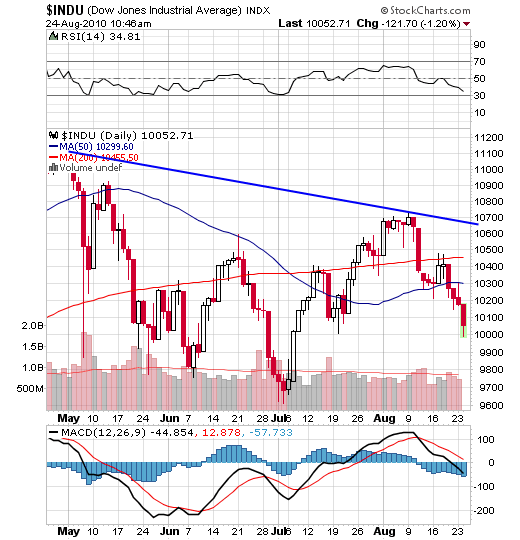
Somehow, I get the same feeling about the stock market. The market gained initial upside momentum as it surged up from its July low. By early August the market had lost upward momentum. For seven days the Dow moved sideways as if suspended in midair. On August 11, the market suddenly plunged 265 Dow points, and in so doing it fell out of its sideway trading range. From there, the Dow whipped back and forth, and by August 19, the Dow had fallen bearishly below both its 59-day and 200-day moving averages.


The daily chart below shows us what the Dow looks like now. Note that RSI is heading down, and MACD has turned negative. At the same time, the Dow is situated below its 50-day moving average, and the 50-day MA, in turn, is below its (red) 200-day MA. Finally, note that the Dow has assumed the form of a head-and-shoulders top that has now broken down. In all, a classic set of bearish relationships. 


I'm including a P&F chart of the Dow below. Note the latest red column of X's which just plunged below the 10150 box and below the rising blue trendline. According to this P&F chart, we received a "sell signal" this morning when the Dow broke below the preceding column of 0s and below it rising blue trendline. The P&F "projection" is that this break should take the Dow down to the 9750 box.


Incidentally, there is no shortage of "distribution days." The latest score for the last two weeks is -- 6 for the S&P 500, 5 for the Dow, 5 for the NASDAQ and 5 for the NYSE Composite. That's far too many, and it implies heavy institutional selling.
Yesterday, I wrote about the Treasury bonds. Every "smart" trader and investor has rushed into Treasury bonds as the ultimate save-haven area. I believe Treasury bonds and high-grade corporate bonds are in a bubble. There are just too many believers in bonds as the ultimate safe place to be. 


When everybody piles onto one side of the ship, the ship lists. And just as quickly, everybody rushes to the other side of the ship. That's where I think we are with bonds. 


The weekly chart below follows the 30-year T-bond. RSI tells us that the bond is overbought. The full stochastics at the bottom of the chart confirms that the bond is overbought. And the blue histograms are slanting downwards towards zero. All in all, I don't like the looks of the bonds. Any hint of rising interest rates could send the bond market off the edge of the popularity cliff. 


Gold -- I took today's stock market sell-off as an indication that business will be rotten in the months ahead. Rotten business will put pressure on the Fed to print, print, print. Wide open quantitative easing will put pressure on the dollar, and this, in turn, will put UPWARD pressure on gold. And gold may have started to discount that situation today.


Share |
_______________________________________
Check it out on The MasterCharts

Saturday, August 21, 2010

Gold: The Enemy of Currencies

Gold: The Enemy of Currencies
Last week saw gold prices rise despite deflationary fears.
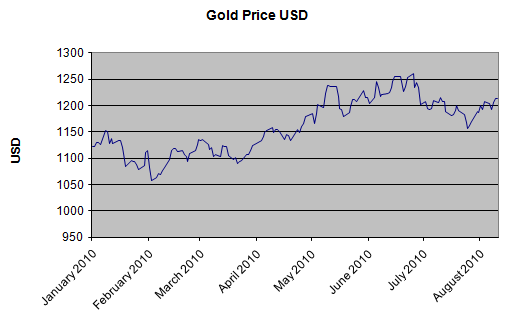
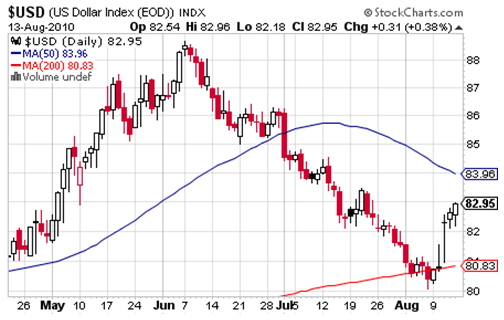
Taking a look at the chart below we can see the gold price in US dollars has traded in a narrow range since May. This is despite the dollar declining for much of that time, see chart further below. (Click to enlarge)
 

 We noted last week that we were going to keep an eye on the Fed Open Market Committee meeting in case they decided to increase the money supply even further. But they didn’t.

The Federal Open Market Committee failed to commit to anything... they didn’t say they would resort to more quantitative easing... they didn’t say they wouldn’t. Instead they’re pausing for breath.

The inflation, deflation debate continues 
As the deflationary, inflationary debate continues to be waged between financial heavyweights we stand on the side and watch. We’ve always believed the act of quantitative easing is inflationary; It inflates the money supply. We also think the governments only way out, of this huge debt burden it has imposed upon itself, is to inflate the debt. If you make the value of your debt less you have less to pay back, but it’s a juggling act. Inflate too much and you run the risk of hyperinflation, something that, the Germans will tell you, doesn’t bode well for an economy.

US Trade Deficit
What’s the next move for gold? We have to wait and see what happens around the globe to find that out. Certainly, its course is no longer dictated by the movement of the dollar as much as it once was. Will this relationship resurface? Probably, but when it does it will most likely be when the dollar makes a significant move, triggering panic in the dollar or gold.

Which is more likely – a panic or strength in the dollar?
Last week Bloomberg reported that the US trade deficit has swelled to an incredible figure:
“The U.S. trade deficit widened by $7.9 billion in June, the most since record-keeping began in 1992, to $49.9 billion, a report from the Commerce Department showed. Exports posted the biggest decline since April 2009.

“Investors should prepare for “major structural changes” as the global economy shifts to slower growth, Mohamed A. El- Erian, chief executive officer at Pacific Investment Management Co. said yesterday in a radio interview on “Bloomberg Surveillance” with Tom Keene.”

This news reverberated around the markets.

A quick look at the VIX index shows us that fear has reentered the market... again. At the far right of the graph you can see the index rises sharply which signifies a growing fear of volatility in the markets.


With a stuttering economy and growing tension between the US and China, the trade balance could play a huge role in a dollar devaluation. But in order for the dollar to drop further people will have to lose faith in its safe haven status. Which means an alternative currency will need to take its place. The problem with this scenario is that there aren’t too many other candidates for the role as a global reserve currency. And whilst that is the case gold can continue to take center stage.

Will things get better?
In the grand scheme of things the debt, from Dubai to Greece has just been shuffled around. The run up in the stock markets suggests stability but investors are cautious. They’re wondering if this is another ‘suckers rally’. And they’re right to be cautious. If you play with fire... well you know that old saying. In other words it doesn’t end well.
Can things get better? That depends on what governments do.

More money printing can only add to the attractiveness of gold. But gold is the enemy of currencies. As Alan Greenspan once noted, to control the dollar you have to control the gold price.

The fight for governments around the world is one which is traded in blows against the gold price. And should they win the price of gold may very well settle back to lower prices until supported by a strong level of jewelry demand. But this is dependent on currencies being kept under control. Both the US and the UK have not ruled out further money printing, and with each new wave of money the original currency is worth less and less.

It all sounds too reactionary to us. There doesn’t seem to be a grand plan. Maybe there cannot be as the markets lead themselves. But whatever the case, none of the actions by those in power have any finiteness about them. There’s no plan and no control.

Disclosure: No positions
http://seekingalpha.com/article/221174-gold-the-enemy-of-currencies?source=feed
Share |
_______________________________________
Check it out on The MasterCharts

Friday, August 20, 2010

A Brief History of the Dollar

A Brief History of the Dollar

Calafia Beach Pundit submits:


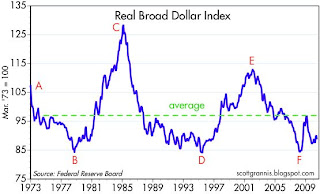
Here, in a nutshell, is my version of the history of the dollar's history, with a focus on its major turning points. As a point of reference, I'm using the Fed's Real Broad Dollar Index (chart above), which measures the dollar's value against a large basket of trade-weighted currencies, all adjusted for changes in relative inflation. It's arguably the best measure of the dollar's true value against other currencies. I've marked 6 key turning points in the dollar, and I explain here the key events occurring around the time of each turning point. I also opine on the future of the dollar.

A: Most measures of the dollar's value only go back to 1973. That's unfortunate, since the modern history of the dollar begins in August 1971, when Nixon ended the dollar's convertibility into gold. Prior to that point, the dollar had been fixed to gold at $35/oz. since 1934, and most of the world's currencies were pegged in some fashion to the dollar. Nixon's decision to abandon the gold standard was the catalyst for what would eventually prove to be a major devaluation of the dollar. The underlying cause of the dollar's collapse, however, was the Fed's decision to ease monetary policy in support of Great Society spending programs. The Fed's easy money policy started in the mid-1960s, and it was reflected in a steadily increasing outflow of gold. The Fed was holding interest rates at artificially low levels, and this was undermining the world's confidence in the dollar. Central banks began demanding gold in exchange for their dollar holdings, until Nixon's decision put an end to that. That decision effectively relieved the Fed of the need to raise interest rates significantly, which in turn exposed the fact that there was a huge excess supply of dollars in the world.

Complete Story

A Brief History of the Dollar

https://blogger.googleusercontent.com/img/b/R29vZ2xl/AVvXsEjYxDjFUf_c6oeNNdKQnrdRle3D82T8VYtKBHFbcb_Yv6DCCh2MwtMQ1jvqRiaDMzwYLrFSFdbto-_pwdfW7WZNH2JrYy7gWSVk6p6hkCy9EBmBgCTAMKUgSIFDBRfnZF8y5MsWtw3NNsU/s1600/Real+Broad+Dollar+Index

-- The MasterFeeds

Thursday, August 19, 2010

Bankruptcies: Going for broke | The Economist


Bankruptcies: Going for broke | The Economist: "Bankruptcies rise in America
Aug 18th 2010

BANKRUPTCY filings rose 20% in the year to June 30th compared with the previous 12-month period, according to statistics released on August 17th by the Administrative Office of the US Courts. This takes quarterly filings to their highest point since tougher bankruptcy laws were introduced at the end of 2005. That change brought a spike of bankruptcies, as companies and individuals rushed to declare themselves broke under the more lenient old regime. The data suggest that an older trend is reasserting itself. This is could be more bad news for America—or it could just mean that creative destruction is alive and well."

________________________

Thursday, August 12, 2010

U.S.-China Trade Gap Stirs Lawmakers - WSJ.com


U.S. Lawmakers Gear Up to Seek New Yuan Policy

WASHINGTON—The U.S. trade deficit with China in June hit its highest level in nearly two years and could spur congressional pressure on Beijing to revamp its currency policy.

America's trade deficit with China jumped 17% in June over the previous month to $26.2 billion, the biggest gap since October 2008. Earlier this week, China said its overall trade surplus hit $28.7 billion in July, an 18-month high.
Associated Press
A production line in Guangdong province, in southern China, in May.

The Commerce Department figures could set the stage for a fight in Congress this fall over China's currency policy. Some lawmakers, arguing that China has set the yuan artificially low to make its exports more price competitive on global markets, are keen to pass laws that would penalize countries that are found to be manipulating their currencies.

China, under pressure from the U.S. and other countries, announced a shift to a more-flexible exchange rate in June. But the yuan has appreciated less than 1% since then, and some economists say that it remains undervalued against the dollar by at least 25%.

While efforts to pass such legislation have made little headway, lawmakers and industry groups agree that the issue could gain traction in September, given that voters, who head to the polls in November, are angry about the country's continued weak economy and high unemployment rate.

A number of bills have garnered bipartisan support, including measures promoted by Tim Ryan (D., Ohio) and Patrick Murphy (D., Pa.) in the House, and by Charles Schumer (D., N.Y.) in the Senate.

These efforts would, among other things, make it easier for companies to seek import duties on goods from countries designated as having undervalued currencies. The Ryan-Murphy bill has more than 127 co-sponsors, including 37 Republicans.

Nadeam Elshami, a spokesman for House Speaker Nancy Pelosi (D., Calif.), said the House Ways and Means Committee would hold a hearing on the currency issue in September after Congress returns from summer recess.

"But no final decisions have been made on moving legislation forward," he said.

Sen. Sherrod Brown (D., Ohio), a co-sponsor of the Schumer bill and a member of President Barack Obama's Export Council, wrote Mr. Obama on Aug. 4, urging the administration to take tougher measures to address "unfairly subsidized exports" by countries such as China. Ten other senators signed the letter, including Republicans Jim Bunning of Kentucky and Olympia Snowe of Maine.

The Treasury Department on Wednesday declined to comment on the U.S.-China trade gap or China's currency policy.

Business groups are expected to intensify their lobbying on the issue, although they differ over whether punitive legislation aimed at China's currency policy is the best solution for narrowing the U.S.-China trade gap.

Augustine Tantillo, executive director of the American Manufacturing Trade Action Coalition, a Washington trade group representing U.S. manufacturers, says the group backs the Ryan-Murphy bill and is lobbying lawmakers, targeting those from Midwestern and Southeastern states with large manufacturing sectors and high unemployment.

"These trade surpluses aren't a result of happenstance," he said. "We're hoping concerns about job creation and the fall election environment will finally give us an opportunity to bring the legislation to a vote."

Erin Ennis, vice president for the U.S.-China Business Council, which represents U.S. companies doing business in China, said the window for China to "show it was serious" about addressing U.S. concerns about the yuan would close in September, when Congress returns to session.

But while Ms. Ennis expected the Chinese currency policy to be a major issue in the fall, "this isn't our member companies' top priority," she said.

Rather, she said that Congress and the administration should focus on reducing barriers to China's market and on the country's new "indigenous innovation" policy, which many Western companies say unfairly favors Chinese companies by promoting domestic innovation.
Write to Kathy Chen at kathy.chen@wsj.com
U.S.-China Trade Gap Stirs Lawmakers - WSJ.com
_______________________________________
Check it out on The MasterCharts

ShareThis

Gold or Silver?

MasterSearch