MasterSearch

Showing posts with label Euro. Show all posts

Thursday, March 05, 2020

#Dollar-#Euro has had a wild ride in the last month...


Share
_______________________________________
Check it out on The MasterCharts

Friday, September 09, 2011

Global Currency Wars Sees Swiss Franc Devalue 8.5% Against Gold In Week | ZeroHedge

Gold in Swiss Francs

Gold in Swiss Francs – 5 Day (Tick)


Gold in Swiss Francs in Nominal Terms – 40 Years (Quarterly)
From zerohedge.com:
The Swiss franc’s 10% plummet against gold this week clearly shows how cash is far from ‘king’ and no fiat currency in the world, in any bank in the world can be considered a “safe haven”.
Gold is again becoming the sovereign of sovereigns and reasserting itself as the safe haven money and asset par excellence.
If the Swiss franc, long considered the safest fiat currency in the world, can devalue 10% in a week, then it can happen and likely will happen to other currencies as well.


Global Currency Wars Sees Swiss Franc Devalue 8.5% Against Gold In Week | ZeroHedge


Share
_______________________________________
Check it out on The MasterCharts

Switzerland's central bank EIU ViewsWire


see the whole article here and here:Switzerland's central bank EIU ViewsWire

Share
-- The MasterFeeds

Thursday, November 25, 2010

infographic: bailout mechanisms in Europe


As for those who still may be confused by how the various bailout mechanisms in Europe operate, we present to you this useful infographic by the Guardian.


http://the-masterblog.blogspot.com/2010/11/its-official-there-is-not-enough-money.html


Share this|
________________________

Friday, September 17, 2010

CNBC Market Blah, Blah ..Friday Look Ahead: Tech a Focus for Stocks Friday, as Gold Dazzles Investors

Friday Look Ahead: Tech a Focus for Stocks Friday, as Gold Dazzles Investors

Published: Thursday, 16 Sep 2010 | 9:10 PM E
By: Patti Domm
CNBC Executive Editor
Some good news from the tech sector could be a positive for stocks Friday.
Outside the New York Stock Exchange in lower Manhattan.
Photo: Oliver Quillia for CNBC.com
Outside the New York Stock Exchange in lower Manhattan.

Both Oracle and Research in Motion reported strong earnings after Thursday's bell. Separately, Texas Instruments boosted its $0.12 dividend by a penny and said it would buy back another $7.5 billion shares. All three stocks were higher in after-hours trading.
Stocks Friday morning could feel the effect of the quadruple expiration of futures and options. Traders expect the expiration to be low key at the open, and if anything, the impact should be slightly positive.
CPI, at 8:30 a.m., is expected to show a 0.3 percent increase in August consumer prices. Consumer sentiment is expected to improve slightly to a reading of 70, from 68.9 last month, but economists say the strong performance of the stock market this month could push that number a bit higher. August's sentiment reading was the second lowest of the year. Consumer sentiment is released at 9:55 a.m.
Stocks drifted on both sides of the unchanged mark Thursday. The Dow ended up 22 at 10,594, and the S&P 500 was off less than a half point at 1124.  The dollar weakened against the euro, and dollar/yen was barely changed after the Bank of Japan intervened to curb the yen's rise Wednesday.
"This intervention might have higher chances of succeeding, assuming we continue to see relatively acceptable U.S. economic data. That's the critical thing," said Boris Schlossberg of GFT Forex. "...as long as the idea of double dip keeps receding, Treasury yields should stabilize and go back up and that will be critical to dollar/yen."
On the other hand, if we see the 10-year yield move to 2.5 percent, or dip below 2.5 percent, I don't think any amount of money will stem the (dollar) decline," he said.
Barry Knapp, chief equities portfolio strategist at Barclay's, said the initial stock market reaction after a big intervention is often a short-term decline. "For the first couple of days, the market goes down a little bit..the first reaction is to look at the dollar," he said.
The view is "if the dollar is going up, that's bad for earnings, so sell it. Dollar's going down, that's good. That's a very simplistic approach. I don't think it's right at all," he said. "If you look back at 2003, when the Japanese were intervening dramatically, the initial reaction was that the stock market sold off, and then it regained its footing."
Knapp said the intervention at that time was about $360 billion, and he estimated this round could total $250 billion. The BOJ was reported to have bought more than $20 billion Wednesday.
"If somebody puts $250 billion into the markets, event though that money won't be buying riskier assets, it can trigger an effect," he said.
The impact on Treasurys could also be noticeable, he said. Traders have been speculating the Japanese will park their dollar holdings in shorter duration Treasurys. "Initially the Treasury curve steepens, but then that tends to drive investors who were in 2s and 5s to extend out the curve and it starts to flatten. Then it triggers a whole position rebalancing."
All that Glitters
Gold continued to dazzle investors Thursday, scoring its second record settlement of the week. Investors are betting it could try to break the $1,300 level, maybe even as early as next week depending on the outcome of the Fed's meeting Tuesday.  Gold Thursday rose about a half percent to settle at $1273.80.
Gold has faced some high-profile criticism this week, including from investor George Soros who called it a bubble. "If you think about a world where every major country is trying to find a way to devalue its currency, gold looks pretty good in that environment. Personally I think the dollar is going down more. There's lots of reasons why gold will continue to rise. I don't know if I'd buy it, but I know I wouldn't short it," Knapp said.
 http://www.cnbc.com/id/39223276

Wednesday, September 01, 2010

Demonised ‘algos’ push the surge in FX trading - FT.com

Oh, poor "Demonized Algos" !!!

Demonised ‘algos’ push the surge in FX trading

By Jennifer Hughes, Senior Markets Correspondent
Published: September 1 2010 00:04 | Last updated: September 1 2010 00:04
Since the infamous stock market “flash crash” of May 6, high-frequency, or algorithmic, trading has been unwillingly dragged into the political and regulatory limelight.
forex-trading-graphicSo far, however, attention has focused on the role of these high-speed traders in the equity market. Outside the glare of that publicity, it is less well known that on May 7, FX trading volumes reached records, straining the plumbing of these markets.
Some participants argue these strains were partially caused by algorithmic, or algo, traders.
Exactly how much of this can be attributed to algo trading is unclear. However, there is no question that high-frequency traders are a fast-increasing force in FX markets, which is sparking a fierce debate as to their value to the market.
On Tuesday, the Bank for International Settlements reported that average daily turnover in the FX market has jumped 20 per cent in the past three years to $4,000bn a day. Its survey was taken in April, so missed the May spike, which related to the eurozone sovereign debt crisis.
The BIS-reported gains were led by a near 50 per cent leap in spot trading – deals for immediate delivery – to $1,500bn a day. This jump was powered by increased activity from “other financial institutions”, a group that includes hedge funds, pension funds, some banks, mutual funds, insurance companies and central banks. This will also include algos.
While all categories of “other” could have increased their trading, it is likely a significant proportion was driven by algo traders, who favour the deep, liquid spot markets and particularly currency pairs such as eurodollar and dollar-yen, which between them account for 42 per cent of all currency trading.
The question for the FX market is whether high-frequency dealers improve the market by adding liquidity, or whether they are instead merely price takers who contribute little.
“Algos have been demonised, but they’re an important part of the growth story,” says David Rutter chief executive of Icap Electronic Broking, which runs EBS, the main FX interbank trading platform. “What we’ve found is that they add pressure at each price point so that instead of getting big price gaps on shocking news, trade is more orderly.
“With FX, there are a lot of other flows such as global trade, so there is good underlying liquidity that the algos can enhance.”
Algos initially appeared in FX markets almost a decade ago, attracted by the deep liquidity and increasing use of electronic trading. They were generally welcomed, particularly by banks looking to build their prime brokerage businesses. However many banks soon grew disenchanted when they found the fast-moving shops were profiting from banks’ own slow systems by exploiting brief, tiny price differences between rival platforms.
Some banks went as far as ejecting offenders from their platforms but banks’ views have since become more nuanced. They have generally reached an accommodation, helped by technological improvements which make it easier to monitor client dealings and offer client-specific prices.
“The facts are that algos have made the markets more efficient and have helped ensure there’s one virtual price,” says Jeff Feig, global head of G10 FX at Citigroup. “They do cause banks to be smarter and we’ve had to work harder to be more efficient, but that’s ultimately to the advantage of the end user.
“I think that to some extent, algos have pushed banks and the result has been enhanced transparency and increased liquidity.”
Algos mean many different things in the FX market. While high-frequency traders are the best known – typified by one senior banker as “five smart guys in a room in New Jersey,” – banks are increasingly adept at developing their own algorithms to make their internal FX deals more efficient. These “internalisation” trades too will have provided a boost to the BIS numbers.
Most players say algos are now a fact of life in currency markets.
Unlike the equity market, which is split into hundreds of stocks, they believe the FX world’s focus on a relatively small number of currency pairs means it would be far harder for a single group of participants to move the market significantly, intentionally or otherwise, as some watchers fear happened during the “flash crash”.
“Also trading can happen anywhere there’s an electronic execution system and a volatile market,” says Alan Bozian a former FX banker and now chief executive of CLS Bank, the FX settlement system. “The question is, which markets adapt well and I don’t think it’s necessarily the stock market.”
FX markets have proved generally good at adapting. Systems such as CLS, introduced years before the financial crisis, have helped minimise settlement risk and since May, participants have been working again to improve their processing systems to cope with increased volume.
Significantly, for a market that is very much built around a hub of big banks, the BIS report showed that, for the first time, interaction of the main banks with “other” financial institutions overtook trading between themselves.
This could be a pointer to the market of the future, where banks are likely to remain the hub, but as much for their trade processing abilities as for their liquidity.
This would allow the winners to build profitable volume without taking on huge trading risks – suiting the current regulatory mood.
“The banks want to continue being the price providers, but they’re getting much more interested in the infrastructure and improving that,” says Mr Bozian. This evolution is likely to apply to high-frequency trading too.
Mr Rutter believes algos are only in their “late teens” in terms of development. “The early algo trading was about super-fast dealing and chasing inefficiencies. That’s largely gone,” he says.
“Now its about math and science being thrown at the market – there’s a rich pool of data and I think we’ll see algos evolve so its not just about milliseconds, but about longer-term predictive math.”
"FT" and "Financial Times" are trademarks of the Financial Times. Privacy policy | Terms


FT.com / Currencies - Demonised ‘algos’ push the surge in FX trading

Share
-- The MasterFeeds

Friday, August 20, 2010

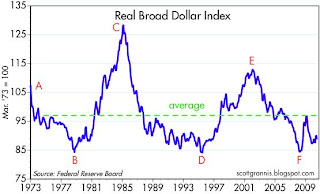
A Brief History of the Dollar

A Brief History of the Dollar

Calafia Beach Pundit submits:


Here, in a nutshell, is my version of the history of the dollar's history, with a focus on its major turning points. As a point of reference, I'm using the Fed's Real Broad Dollar Index (chart above), which measures the dollar's value against a large basket of trade-weighted currencies, all adjusted for changes in relative inflation. It's arguably the best measure of the dollar's true value against other currencies. I've marked 6 key turning points in the dollar, and I explain here the key events occurring around the time of each turning point. I also opine on the future of the dollar.

A: Most measures of the dollar's value only go back to 1973. That's unfortunate, since the modern history of the dollar begins in August 1971, when Nixon ended the dollar's convertibility into gold. Prior to that point, the dollar had been fixed to gold at $35/oz. since 1934, and most of the world's currencies were pegged in some fashion to the dollar. Nixon's decision to abandon the gold standard was the catalyst for what would eventually prove to be a major devaluation of the dollar. The underlying cause of the dollar's collapse, however, was the Fed's decision to ease monetary policy in support of Great Society spending programs. The Fed's easy money policy started in the mid-1960s, and it was reflected in a steadily increasing outflow of gold. The Fed was holding interest rates at artificially low levels, and this was undermining the world's confidence in the dollar. Central banks began demanding gold in exchange for their dollar holdings, until Nixon's decision put an end to that. That decision effectively relieved the Fed of the need to raise interest rates significantly, which in turn exposed the fact that there was a huge excess supply of dollars in the world.

Complete Story

A Brief History of the Dollar

https://blogger.googleusercontent.com/img/b/R29vZ2xl/AVvXsEjYxDjFUf_c6oeNNdKQnrdRle3D82T8VYtKBHFbcb_Yv6DCCh2MwtMQ1jvqRiaDMzwYLrFSFdbto-_pwdfW7WZNH2JrYy7gWSVk6p6hkCy9EBmBgCTAMKUgSIFDBRfnZF8y5MsWtw3NNsU/s1600/Real+Broad+Dollar+Index

-- The MasterFeeds

Wednesday, August 11, 2010

Is Gold Crash Proof This Time Around? | zero hedge

Is Gold Crash Proof This Time Around?

I’ve been receiving quite a few emails regarding the topic of Gold and how it will perform if another Crash hits. The following are my thoughts on this matter.

The first thing that needs to be said is that IF we have another systemic meltdown like that of Autumn 2008, Gold will likely go down along with everything else. There are simply too many big players (hedge funds, investment banks, etc) with heavy exposure to Gold who would be forced to liquidate their positions during a systemic collapse.

I know this is not what the Gold bugs want to hear, but during systemic Crises, just about every investment on the planet plunges while the US Dollar and Treasuries rally. Of course, this time around if another 2008-type event hits, it will undoubtedly involve or be focused on sovereign debt. So this raises the potential that Treasuries, particularly those on the long-end of the yield curve, could be hammered as well as all other assets outside the Dollar. This is worth keeping in mind for those who view Treasuries as a safe haven.

So if we go into a 2008-type event, Gold will fall. It will likely fall much less than other assets (stocks and industrial commodities), but it will still go down at least at first. This forecast is confirmed by the market action in 2008 as well as the market collapse from April 2010-July 2010. Both times Gold took a hit, but both times it came back quickly.

So if you’re heavily exposed to Gold, you’re going to need to think “big picture” or have a very strong stomach when the market Crashes.

Now, let’s take a look at the charts.

For starters, the number one metric you need to focus on in terms of determining Gold’s market action is the 34-week exponential moving average. Since the Gold bull market began in 2001, this has been THE support line for Gold.

As you can see, Gold has only broken below this line ONCE in the last ten years and that was during the 2008 systemic collapse. So take a note of this line and always watch where Gold trades relative to it.

Indeed, a significant break below this line that DOESN’T occur during a system Crash would be a MAJOR warning that the Gold bull market is in trouble. Remember, the ONLY time we took this line out before was during the systemic collapse in 2008. So a break below it WITHOUT a Crisis would be VERY bearish.

And if Gold breaks below this line on its own (without a Crisis) and then fails to reclaim it… well, then it would be SERIOUS time to reevaluate the Gold bull market story.

Because of its significance as THE support line for the Gold bull market, the 34-week exponential moving average also serves as an excellent gauge for determining when Gold needs to take a breather or correct.

Indeed, anytime Gold has stretched too far away from this line to the upside, it has usually staged a pretty sharp reversal to re-test this line. I’ve circled the most significant episodes of this from the last seven years in red on the chart below.

These are the BIG picture gauges and items to take note of: the points to remember in terms of determining where Gold is in its bull market and whether it’s an asset class you want to “buy and hold.”

Now let’s move into the more intermediate gauges and items relevant to determining Gold’s action from a trading perspective in the past and today.

Gold’s bull market of the last ten years has largely taken place within the confines of several very clear upward trading channels. Indeed, each “leg up” has featured Gold breaking above the upper trend-line of a given channel at which point said upper trend-line became the lower trend-line for the next trading channel (see below).

As you can see, the first “leg up” in Gold’s bull market took place from 2001 to late 2005. At that point Gold broke out of its old trading channel and entered its “next leg up” which took place from 2006-until early 2008 when the Bear Stearns crisis blasted Gold into yet another trading range.

The systemic Crash in Autumn 2008 brought Gold back down into a former range (the only time this happened in the last 10 years), but the precious metal bounced back quickly. It DID have some difficulty breaking into its final “leg up” and staying there this time around, but by mid-2009, Gold was again on a tear entering its highest trading range yet where it remains today.

You’ll note that the clear significance of these various trend lines have made for some great trading: virtually every test of a trend line to the upside or downside made for a good exit or entry point for a short-term trade.

As I write this, Gold is trading in a well-defined range between $1,150 and $1,300. Going by Gold’s action of the last 10 years, we could see the precious metal continue to trade in this range for a while without breaking out either way. This, of course, assumes we don’t have another systemic meltdown AND that the Gold bull market has plenty of more room to run.

The major indicators that could nullify this forecast are:

1) A break below the lower trend line WITHOUT a Crash

2) A break above the upper trend line that held

Regarding #1 [1], if Gold broke below its lower trend line without a systemic “episode,” it would represent the first time Gold broke to a lower trading range without systemic risk. That would be a MAJOR red flag to watch out for if you’re a Gold bull.

Conversely, a significant break above $1,300 would signal yet another “leg up” has begun and would a MAJOR sign that the Gold bull market has plenty of more room to run.

A final significant move to watch for would be if Gold were to collapse into a lower trading range as a result of a Crash and NOT break out again. Even during the 2008 disaster, Gold was back to re-testing its upper trend line within a few months. So if another systemic Crash hits and Gold doesn’t bounce back quickly that’s ALSO a major warning sign that the Gold bull market is in trouble.

We’ve covered a lot of ground here, so I’ll close this article by listing the main points of this article:

1) “buy and hold” Gold investors MUST focus on the 34-week exponential moving average (currently $1,158). A break below this level WITHOUT a Crash is BAD NEWS.

2) Traders should focus on Gold’s trend lines for determining entry and exit points. Currently the trend lines are $1,300 on the upside and $1,150 on the downside.

A break below $1,150 WITHOUT a Crash would be a MAJOR warning to the bulls. So would a break below $1,150 WITH a Crash that wasn’t quickly followed by a strong bounce back and re-test of the upper trend line.

Good Investing!

Graham Summers

PS. to get more in depth market analysis and find out about a proprietary "buy and hold" trading trigger that has caught both major "legs up" in Gold AND avoided the

2008 Crash, you can join me at www.gainspainscapital.com.


Is Gold Crash Proof This Time Around? | zero hedge

Friday, July 23, 2010

Hypo Fails, All Other German, Portuguese, French Banks Pass Test

Tyler Durden
Subject: Hypo Fails, All Other German, Portuguese, French Banks Pass Test

And we uncover that the German Landesbanks (the equivalent of the bankrupt
Spanish cajas) did their own stress tests. Time for the PPT to step in with
this pretext and soak up all offers. Totally pathetic BS.
Update 1: Somehow Bank of Ireland "passes" the test but needs over €2
billion in extra equity... uhm... WTF??? This is the point where the
audience rushes the stage and burns the theater down.
Update 2: 5 Spanish cajas, 1 German and 1 Greek banks are eliminated on
their quest to marry the US taxpayer. 84 other banks will soon be the
recipients of far more US taxpayer generosity. And with that the season
finale of the farce comes to a close.
Description: http://feeds.feedburner.com/~r/zerohedge/feed/~4/f6DsejiAiBk

View article...
Hypo Fails, All Other German, Portuguese, French Banks Pass Test | zero hedge

ShareThis

Gold or Silver?

MasterSearch