MasterSearch

Showing posts with label Banks. Show all posts

Wednesday, March 02, 2022

Not All Banks Are Created Equal

One year since its new CEO came in, Citigroup is right back where it was then. 

JP MORGAN hasn't fared too much better,

Friday, May 06, 2011

Commodities VaRy extreme right now

Commodities VaRy extreme right now

Hark — the standard deviation devils sing (again).
As Reuters columnist John Kemp pointed out yesterday, recent swings in the commodities complex have produced some impressive probabilities figures. The kind you can wheel out in dinner party conversation. For instance, front-month Brent crude futures sank almost $12 per barrel (or over 9 per cent) on Thursday, leading the market down from over $120 at the start of the day to under $110.
That's a price change of more than four standard deviations — which is a statistical way of saying it's something that should be seen on average only once in every 63 years, assuming a normal bell-curve distribution. Kemp also points out that at times on Thursday the move also approached five standard deviations — something which should only occur once every 7,000 years.
Now, who wants to bet that algorithmic trading models, or banks' risk management ones, don't extend to this kind of (rare-ish) movement? After all, these models tend to be based on recent history and banks rarely feel the need to take into account extreme events which have never happened. Such was most famously the case, of course, in credit risk management ahead of the subprime crisis.
It's certainly the thinking behind graphics like the below — from Reuters on Thursday:
That's Value-at-Risk (VaR) for major US banks. In words it would mean, for example, that there's a one in 20 chance that Goldman Sachs' daily commodities trading net revenues would fall below expected daily trading net revenues by an amount at least as large as the reported VaR — or about $37bn in the first quarter. Note that VaR predictions, however, tend to be a poor predictor of actual losses. And banks have the ability to ignore them somewhat, as Goldman Sachs did during the subprime crisis.
Here's Kenneth Posner in his book, Stalking the Black Swan:
The company shorted the ABX index just like the hedge fund in Chapeter 4, earning more than $1 billion in profits during 2007. During this period, senior executives were monitoring the value-at-risk … associated with the firm's mortgage position, as well as grilling the mortgage traders on the rationale for their bets. On separate occasions, the executives forced the traders to downsize their positions, even though the trades were profitable, in order to keep the VaR in check. At other times they allowed the VaR to rise to an all-time high.
Given Goldman Sachs called for Brent to return to $105 a barrel just three weeks ago — much to the amusement of some other banks (likeBarclays Capital) — we're guessing there won't be too much Goldman hand-wringing over size able commodities VaR. If the bank followed its own published advice, it should be well-positioned (once again).
Barclays, incidentally, is one of the few European banks that does not break out its quarterly commodities VaR.


Friday, February 18, 2011

Banks and investment firms have rebounded fastest since March 2009 lows

Chart of the day: Barclays and Lloyds soar since lows

Kit Chellel
18 Feb 2011
4068036725_c300,200,50,50,100.gif

How financial firms in the FTSE100 have performed since the lowest point of the crisis
Two weeks from today is the second anniversary of one of the darkest moments of the financial crisis, when the FTSE 100 fell to a new low and Barclays shares were going for as little as 81p.
On that day, March 3, 2009, the 100 largest companies in the UK were worth less than they were when Tony Blair was elected in 1997.
The FTSE 100 has not hit such depths since, and an equities rally over the past few months has seen the index recover to somewhere near two-year highs.
Figures compiled by Financial News show that banks and investment firms have rebounded fastest, albeit from a lower level.
An investor who bought shares in the 10 financial firms (excluding insurers) currently in the FTSE 100 back in March 2009, would have seen a return of 149% in those two years, based on prices on Thursday morning.
This compares to an average of 73% across the FTSE 100 index.
An investor who backed Barclays would have done even better. The bank, which avoided a government bailout by tapping up Middle Eastern oil money, has risen a staggering 311% in the same period.
Lloyds is up 205% and private equity group 3i 182%.
The worst performer was investment group Alliance Trust whose shares rose 58.8%, which is below the FTSE average.
Second from bottom among the financial firms was Man Group which has been beset by problems since the crash. The listed hedge fund has seen half its assets under management pulled out by investors since the start of the crisis. Despite this, its shares have still gained 92 per cent between March 2008 and now.
The share gains achieved by banks are all the more impressive given that Barclays, HSBC, Lloyds and RBS all carried out multi-billion pound share issues to recapitalise following the crisis, diluting the value of stock.
The FTSE 100 index closed at 6087.38 yesterday, helped by strong performance from Lloyds TSB (up 2.9%) and RBS (up 3.8%). However the index remains some way below the pre-crisis peak of 6721.60 on September 31, 2007.


http://www.efinancialnews.com/story/2011-02-18/barclays-and-lloyd-best-performing-shares-since-crisis-trough?utm_source=twitterfeed&utm_medium=twitter

Thursday, November 25, 2010

infographic: bailout mechanisms in Europe


As for those who still may be confused by how the various bailout mechanisms in Europe operate, we present to you this useful infographic by the Guardian.


http://the-masterblog.blogspot.com/2010/11/its-official-there-is-not-enough-money.html


Share this|
________________________

Wednesday, September 01, 2010

Demonised ‘algos’ push the surge in FX trading - FT.com

Oh, poor "Demonized Algos" !!!

Demonised ‘algos’ push the surge in FX trading

By Jennifer Hughes, Senior Markets Correspondent
Published: September 1 2010 00:04 | Last updated: September 1 2010 00:04
Since the infamous stock market “flash crash” of May 6, high-frequency, or algorithmic, trading has been unwillingly dragged into the political and regulatory limelight.
forex-trading-graphicSo far, however, attention has focused on the role of these high-speed traders in the equity market. Outside the glare of that publicity, it is less well known that on May 7, FX trading volumes reached records, straining the plumbing of these markets.
Some participants argue these strains were partially caused by algorithmic, or algo, traders.
Exactly how much of this can be attributed to algo trading is unclear. However, there is no question that high-frequency traders are a fast-increasing force in FX markets, which is sparking a fierce debate as to their value to the market.
On Tuesday, the Bank for International Settlements reported that average daily turnover in the FX market has jumped 20 per cent in the past three years to $4,000bn a day. Its survey was taken in April, so missed the May spike, which related to the eurozone sovereign debt crisis.
The BIS-reported gains were led by a near 50 per cent leap in spot trading – deals for immediate delivery – to $1,500bn a day. This jump was powered by increased activity from “other financial institutions”, a group that includes hedge funds, pension funds, some banks, mutual funds, insurance companies and central banks. This will also include algos.
While all categories of “other” could have increased their trading, it is likely a significant proportion was driven by algo traders, who favour the deep, liquid spot markets and particularly currency pairs such as eurodollar and dollar-yen, which between them account for 42 per cent of all currency trading.
The question for the FX market is whether high-frequency dealers improve the market by adding liquidity, or whether they are instead merely price takers who contribute little.
“Algos have been demonised, but they’re an important part of the growth story,” says David Rutter chief executive of Icap Electronic Broking, which runs EBS, the main FX interbank trading platform. “What we’ve found is that they add pressure at each price point so that instead of getting big price gaps on shocking news, trade is more orderly.
“With FX, there are a lot of other flows such as global trade, so there is good underlying liquidity that the algos can enhance.”
Algos initially appeared in FX markets almost a decade ago, attracted by the deep liquidity and increasing use of electronic trading. They were generally welcomed, particularly by banks looking to build their prime brokerage businesses. However many banks soon grew disenchanted when they found the fast-moving shops were profiting from banks’ own slow systems by exploiting brief, tiny price differences between rival platforms.
Some banks went as far as ejecting offenders from their platforms but banks’ views have since become more nuanced. They have generally reached an accommodation, helped by technological improvements which make it easier to monitor client dealings and offer client-specific prices.
“The facts are that algos have made the markets more efficient and have helped ensure there’s one virtual price,” says Jeff Feig, global head of G10 FX at Citigroup. “They do cause banks to be smarter and we’ve had to work harder to be more efficient, but that’s ultimately to the advantage of the end user.
“I think that to some extent, algos have pushed banks and the result has been enhanced transparency and increased liquidity.”
Algos mean many different things in the FX market. While high-frequency traders are the best known – typified by one senior banker as “five smart guys in a room in New Jersey,” – banks are increasingly adept at developing their own algorithms to make their internal FX deals more efficient. These “internalisation” trades too will have provided a boost to the BIS numbers.
Most players say algos are now a fact of life in currency markets.
Unlike the equity market, which is split into hundreds of stocks, they believe the FX world’s focus on a relatively small number of currency pairs means it would be far harder for a single group of participants to move the market significantly, intentionally or otherwise, as some watchers fear happened during the “flash crash”.
“Also trading can happen anywhere there’s an electronic execution system and a volatile market,” says Alan Bozian a former FX banker and now chief executive of CLS Bank, the FX settlement system. “The question is, which markets adapt well and I don’t think it’s necessarily the stock market.”
FX markets have proved generally good at adapting. Systems such as CLS, introduced years before the financial crisis, have helped minimise settlement risk and since May, participants have been working again to improve their processing systems to cope with increased volume.
Significantly, for a market that is very much built around a hub of big banks, the BIS report showed that, for the first time, interaction of the main banks with “other” financial institutions overtook trading between themselves.
This could be a pointer to the market of the future, where banks are likely to remain the hub, but as much for their trade processing abilities as for their liquidity.
This would allow the winners to build profitable volume without taking on huge trading risks – suiting the current regulatory mood.
“The banks want to continue being the price providers, but they’re getting much more interested in the infrastructure and improving that,” says Mr Bozian. This evolution is likely to apply to high-frequency trading too.
Mr Rutter believes algos are only in their “late teens” in terms of development. “The early algo trading was about super-fast dealing and chasing inefficiencies. That’s largely gone,” he says.
“Now its about math and science being thrown at the market – there’s a rich pool of data and I think we’ll see algos evolve so its not just about milliseconds, but about longer-term predictive math.”
"FT" and "Financial Times" are trademarks of the Financial Times. Privacy policy | Terms


FT.com / Currencies - Demonised ‘algos’ push the surge in FX trading

Share
-- The MasterFeeds

Thursday, August 12, 2010

FT.com / FT's rolling global market overview - Investors take fright at Fed warning


Investors take fright at Fed warning

ByTelis Demos in London
Published: August 11 2010 09:04 | Last updated: August 11 2010 22:06
Wednesday 21.30 BST. US stocks are tumbling sharply as risky assets react to the Federal Reserve’s decision to downgrade its outlook while at the same time growth in other regions looks to be at its weakest for the year.
The Fed’s move to pump up a flagging recovery by buying Treasury bonds with mortgage-backed security proceeds has led to a rush to haven assets. The yen finally broke through to its strongest point since 1995 – at Y84.71 to the dollar, which it has been nearing for weeks.
With the Fed now a buyer of debt, some US government bonds saw record low yields, as did bonds in other markets as investors fled risky assets. An auction of 10-year Treasuries saw the lowest yield of any sale since January 2009.
Equity markets have been severely disappointed by the Fed’s downgrade of its outlook and in its rather tepid response to that outlook (the Fed’s balance sheet will not actually expand). The FTSE All-World stock index has fallen 2.7 per cent to late July levels, its strongest move since June, led by a 2.8 per cent decline in the S&P 500 index.
“The Fed delivered the minimum that had been expected,” said Hans Redeker, global head of foreign exchange strategy at BNP Paribas.“

The Market Eye

Markets saw a pillar of calm wobble today: the relatively high yields on 30-year debt.The recent trend has been of weakness at the back of the curve, suggesting investors were not expecting serious deflation. But today 30-year yields came in, and the spread with 10-years narrowed. It’s still near all-time record highs, so views haven’t shifted, only slid slightly. Plus, the move is likely short-lived, given the way that markets trade on Fed moves. Steven Major, head of fixed-income research at HSBC, says distortion is the rule-of-thumb in these situations:
“Given that this action by the Fed was well telegraphed, Treasury yields have moved lower in a move which is beyond what we expected,” he said. “The biggest moves tend to happen when markets are salivating about the prospects. Normally when an expected event happens, the reaction is a damp squib.”
Mr Major said that given the markets’ bearish tilt on the economy, yields on 10-year US Treasuries could fall as low as 2 per cent, from
2.69 per cent currently. That would blow the curve right back out to record levels.
A report that the US trade deficit widened again in June to 2009 levels sent its own shockwaves through markets. Combined with a slowdown in industrial production in China to two-year lows, and a drop in machine orders in Japan, it confirmed suspicions that the rest of the world would not be able to help the world’s biggest economy grow.
“Without earnings season holding us up, investors are focusing on the bad news,” said Jonathan Corpina, a senior partner at Meridian Equity Partners and trader on the New York floor. “We heard this language from the Fed on Tuesday. Really it was the combination with the numbers from China and the trade balance that put extreme pressure on our markets today.“
Crude oil’s decline also accelerated following a warning from the International Energy Agency that the Gulf of Mexico oil spill may restrict supply in 2011. It has slipped below $80 a barrel.
The fears for global growth were especially sharp in Europe, where oddly the dollar surged against the euro in spite of monetary loosening in the US.
“Investors are looking at Europe and saying, ‘I don’t care about policy tightness’. If the US has a real risk of weakness, then that raises risks for growth everywhere in the world,” said Eric Fine, manager of G-175 funds at Van Eck Global.
The euro is at its lowest level since before the bank stress tests last month. German 10-year Bunds are also at record low yield levels as “peripheral” European bonds from Greece and Spain are sold-off.
Europe. Mervyn King, governor of the Bank of England, said in his inflation outlook that economic growth would slow to below-target levels. The UK also saw a stark drop in consumer confidence and fallingemployment growth. Like the Fed, the Bank announced that quantitative easing would continue, but not extended to new levels.
The FTSE 100 index dropped 2.4 per cent, falling further after Wall Street’s weak opening, but already weak following the UK’s dismal data and the Bank of England’s unwillingness to provide new monetary relief. Germany’s Dax closed down 2.1 per cent. Basic materials, closely tied to demand in China, and cyclical technology and financial shares are the laggard sectors.
• Asia. The Nikkei 225 average fell 2.7 per cent as the yen jumped following the Fed decision. A stronger yen has weighed on Japanese export companies. Japan also said that industrial orders rose only 1.6 per cent in July, versus a forecast of 5.5 per cent growth.
Chinese shares were also lower on the poorer industrial growth figures. The mainland Shanghai Composite index was down by 0.5 per cent and the Hang Seng index in Hong Kong dropped 0.8 per cent, falling lower as it neared the close.
• Currencies. The yen has since bounced off its low of Y84.79, and is now up 0.1 per cent at Y85.38. Considerations such as haven buying for the dollar, and the risk of Japanese intervention in the market, have kept the currency from rising further.
The euro is down 2.3 per cent at $1.2870, its steepest one-day drop since January 2009. It has given up all its gains following the well-received bank stress tests. The yen is surging 2.4 per cent against the euro to Y109.89.
The pound was hard-hit following a jobs report in which the decline in jobless claims slowed, and the Bank of England’s inflation report. Sterling is down 1.2 per cent, at $1.5665, after falling more than 1 per cent in the previous session.
The New Zealand dollar is off 1.2 per cent against the yen and the Australian dollar is down by 1.7 per cent against the US dollar. Both currencies closely track commodities and interest rates, which rise with growth hopes.
• Debt. The German 10-year Bund was the sharpest mover, with the yield falling 11 basis points to 2.43 per cent, a new record low.
Japanese 10-year yields fell 2 basis points to 0.999 per cent.
The yield on the US 10-year Treasuries is down 7 basis points to 2.69 per cent, off its lowest point since February 2009 hit earlier in the session. Five-year bonds, 7-year, and 2-year bonds also dipped to record-low yields, though they had recovered slightly as the session wore on.
Gilt yields also fell sharply, with 10-year bonds down 11bp to yield 3.14 per cent, their lowest since April 2009 following the Bank’s dovish outlook. An auction on Tuesday saw long-dated gilts pricing at below-market yields, though not strongly in demand by investors.
• Commodities. Benchmark crude oil is falling further past $80 a barrel, now at $77.51, down 3.4 per cent.
Gold, in one of the few signs of reassurance, is down just 0.5 per cent at $1,199 an ounce. Bullion interests investors as the risk of monetary inflation rises and the Fed’s relatively cautious move has evidently not sparked a change in fears of either inflation or deflation.
However, traders cautioned that big moves in gold may be muted by liquidations that raised cash for investors fleeing risk.
Follow the Global Market Overview on Twitter @telisdemos
(Jamie Chisholm is on holiday)

Tuesday, July 27, 2010

High frequency trading accounts for 60 per cent of U.S. equity trading, says Reuters

High frequency trading accounts for 60 per cent of U.S. equity trading, says Reuters
And the average trade is held for less than 10 seconds.......


According to Reuters, high frequency trading accounts for 60 per cent of U.S. equity trading. Last week, the U.S. Commodity Futures Trading Commission began a series of meetings with exchanges, including equity exchanges, to decide if it should place controls on algorithmic or high frequency traders.

While the U.S. markets could face regulations, many news outlets say Asia is joining what the media has taken to calling the "global trading arms race." Reuters says that currently only 30 per cent of equity trading is high freqency in Tokyo and Singapore, however exchanges in Tokyo, Singapore and Hong Kong are planning upgrades to accommodate high frequency traders from the U.S. and Europe.

Hong Kong Exchanges & Clearing's website say it hopes to increases its order processing speed to 15,000 transactions a second from 3,000 transactions by 2011. Earlier this year, the Tokyo Stock Exchange and Fujitsu introduced their $145-million (U.S.) trading platform called Arrowhead. It executes trades in under five milliseconds. The TSE's website says it is hoping to increase its trading speed further in the next few years. Singapore is also trying to increase trading speeds. Its website
says it is building the "world's fastest trading engine," SGX Reach, which it hopes to complete by the beginning of 2011. The SGX says the new $250-million (U.S.) engine will carry out trades in 90 microseconds, which is 55 times faster than Tokyo's Arrowhead. 


Pure Trading third again, Asia joins arms trading race


2010-07-19 20:46 ET - Street Wire


by Stockwatch Business Reporter

Pure Trading was the third most active of Canada's alternative trading systems in the week ended July 16, 2010. The leader, once again, was Alpha Trading Systems, which averaged 133.1 million shares per day. In second place was Chi-X Canada, with 34.9 million shares, followed by Pure Trading with 30.2 million shares. In fourth place was dark pool Match Now with 6.8 million, and in last was Omega ATS with 3.9 million shares per day. Combining their volumes, the ATSs accounted for 29.1 per cent of the market.

Alpha will introduce a new trading facility, Alpha IntraSpread, in the fourth quarter of this year. Alpha IntraSpread will offer a pair of new order types that will allow dealers to seek matches within their firm for guaranteed price improvement. Alpha Group chief executive officer Jos Schmitt says Alpha IntraSpread fees will be the lowest of any marketplace in Canada.

The two new orders types are "dark" and "seek dark liquidity." The dark order is fully hidden and will only trade with incoming seek dark liquidity orders. Alpha will cancel any seek dark liquidity order that does not trade immediately.

According to Reuters,
high frequency trading accounts for 60 per cent of U.S. equity trading. Last week, the U.S. Commodity Futures Trading Commission began a series of meetings with exchanges, including equity exchanges, to decide if it should place controls on algorithmic or high frequency traders.

While the U.S. markets could face regulations, many news outlets say Asia is joining what the media has taken to calling the "global trading arms race." Reuters says that currently only 30 per cent of equity trading is high freqency in Tokyo and Singapore, however exchanges in Tokyo, Singapore and Hong Kong are planning upgrades to accommodate high frequency traders from the U.S. and Europe.

Hong Kong Exchanges & Clearing's website say it hopes to increases its order processing speed to 15,000 transactions a second from 3,000 transactions by 2011. Earlier this year, the Tokyo Stock Exchange and Fujitsu introduced their $145-million (U.S.) trading platform called Arrowhead. It executes trades in under five milliseconds. The TSE's website says it is hoping to increase its trading speed further in the next few years. Singapore is also trying to increase trading speeds. Its website says it is building the "world's fastest trading engine," SGX Reach, which it hopes to complete by the beginning of 2011. The SGX says the new $250-million (U.S.) engine will carry out trades in 90 microseconds, which is 55 times faster than Tokyo's Arrowhead.

Friday, July 23, 2010

Hypo Fails, All Other German, Portuguese, French Banks Pass Test

Tyler Durden
Subject: Hypo Fails, All Other German, Portuguese, French Banks Pass Test

And we uncover that the German Landesbanks (the equivalent of the bankrupt
Spanish cajas) did their own stress tests. Time for the PPT to step in with
this pretext and soak up all offers. Totally pathetic BS.
Update 1: Somehow Bank of Ireland "passes" the test but needs over €2
billion in extra equity... uhm... WTF??? This is the point where the
audience rushes the stage and burns the theater down.
Update 2: 5 Spanish cajas, 1 German and 1 Greek banks are eliminated on
their quest to marry the US taxpayer. 84 other banks will soon be the
recipients of far more US taxpayer generosity. And with that the season
finale of the farce comes to a close.
Description: http://feeds.feedburner.com/~r/zerohedge/feed/~4/f6DsejiAiBk

View article...
Hypo Fails, All Other German, Portuguese, French Banks Pass Test | zero hedge

Monday, June 28, 2010

Changing Central Bank attitudes: gold to be strongest asset class - GOLD ANALYSIS | Mineweb


Changing Central Bank attitudes: gold to be strongest asset class

Poll of Central Bankers suggests they expect gold to outperform equities, bonds, currencies - and oil. If they aren't selling gold it's probably a good job that no-one wants to borrow it either.
Author: Rhona O'Connell
Posted:  Friday , 25 Jun 2010 


LONDON - 
At its recent annual seminar for reserve management, investment bank UBS polled over 80 reserve managers from the official sector as to their views on different reserve assets.  One outcome was that gold was expected to be the strongest asset class in the second half of this year, while 22% of those polled thought that gold would be the most important reserve asset over the next 25 years.
This may seem like a long time horizon, but central bankers have to think in the long term as custodians of national wealth (expect, of course, when governments get in the way and insist on, for example, gold disposals with prior publicity).  The view underpins the swing in attitudes towards gold in the official sector that has been evolving.  Clearly the shifting tides in sentiment are informed by increased concern over fiscal imbalances, currency dislocations and sovereign risk, all of which have escalated over the past eighteen months, and which are therefore helping to change a trend of sales that was most-recently re-established in 1989.
Figures from Consolidated Gold Fields (as was) and GFMS Ltd, which assumed responsibility from Consolidated Gold Fields for compiling the Gold Survey when the former company was taken over by Hanson Trust (after a mighty tussle with Minorco) in 1989, show that over the 62 years 1948 to 12009 inclusive, the official sector has been a net seller for 34 years, or 55% of the time.  The sector was a net buyer from 1948 through to 1966, during which time it absorbed almost 8,000 tonnes.  Since then it has offloaded just over 10,000 tonnes, with world holdings, as reported to the IMF, standing at a shade below 30,200 tonnes.  The latest figures for world holdings, which relate to end-March, show a tonnage of 30,463t, reflect a 180t reclassification of Saudi's holdings, while much of the balance of the increase registered to "all countries", some 39 tonnes, comes from the acquisition programmes of Russia and the Philippines, plus, to a lesser extent, Venezuela. 
Annual and cumulative changes in the official sector's gold mountain (metric tonnes) - back to the post-world war II position?

CBGA signatories have, since the first Agreement was signed in September 1999, been responsible for 3,906 tonnes of the official sector's net disposals, equivalent to approximately 90% of the total. CBGA sales have collapsed this year with less than one tonne coming onto the market under CBGA3 so far this calendar year.  The majority of sales into the market since January have come from the IMF, which has sold almost 39t into the open market this year, leaving almost 153t to go. 
The implication from official statements from both the CBGA signatories and the IMF itself suggest that any further disposals into the open market (and it would look likely that the balance of the metal will come on-market unless a fresh central bank suddenly appears on the scene) will be worked, at least on a de facto basis, under the auspices of the CBGA.  Once this metal is out of the way then it s entirely possible that the official sector will become a net buyer of gold again for the first time since four years of purchases that amounted to over 630 tonnes (9% of mine supply) in 1985-1988. This was when producing countries were absorbing local production and others - notably Taiwan, amid much publicity, were - wait for it -diversifying away from the dollar....


http://www.mineweb.com/mineweb/view/mineweb/en/page33?oid=106888&sn=Detail&pid=102055

Monday, November 09, 2009

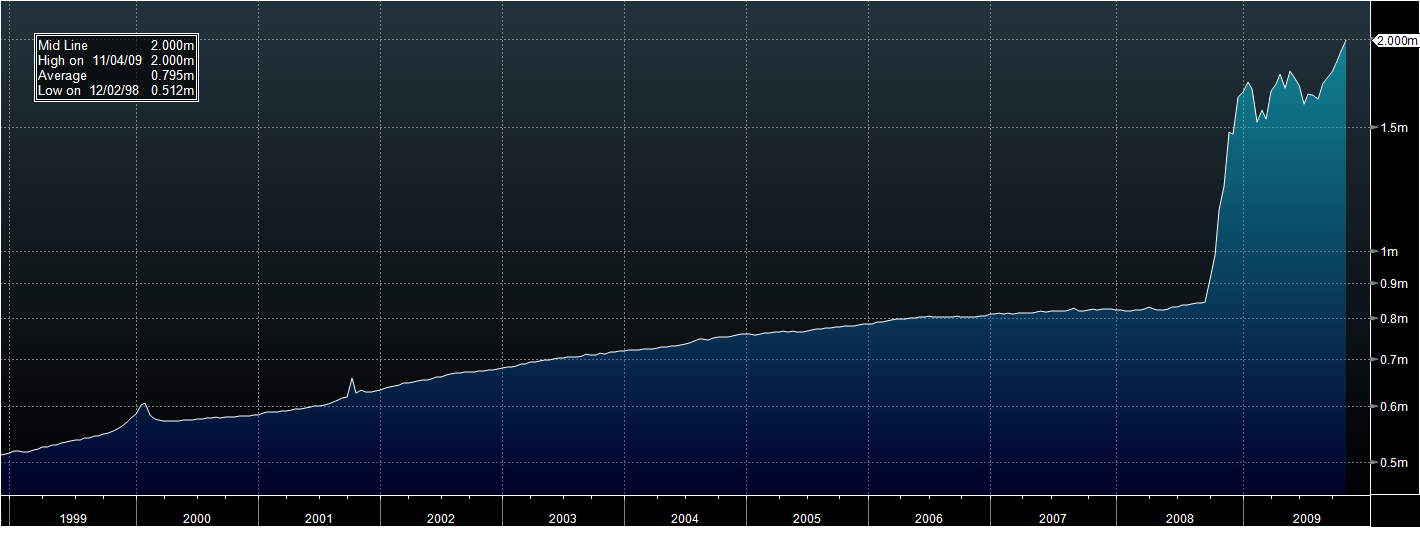
US Monetary Base Expansion

US Monetary Base Expansion

It's gone bonkers!!!


US Monetary Base 1998 - Present
http://static.seekingalpha.com/uploads/2009/11/9/439442-125776588647795-Thomas-MacLeod_origin.png

439442-125776588647795-Thomas-MacLeod_origin.png (PNG Image, 1420x546 pixels)

US Monetary Base 1970 - Present


The Master Blog
www.masterdjm.blogspot.com

ShareThis

Gold or Silver?

MasterSearch