Wednesday 21.30 BST. US stocks are tumbling sharply as risky assets react to the Federal Reserve’s decision to downgrade its outlook while at the same time growth in other regions looks to be at its weakest for the year.
The Fed’s move to
pump up a flagging recovery by buying Treasury bonds with mortgage-backed security proceeds has led to a rush to haven assets. The yen finally broke through to its strongest point since 1995 – at Y84.71 to the dollar, which it has been nearing for weeks.
With the Fed now a buyer of debt, some US government bonds saw record low yields, as did bonds in other markets as investors fled risky assets. An auction of 10-year Treasuries saw the lowest yield of any sale since January 2009.
Equity markets have been severely disappointed by the Fed’s downgrade of its outlook and in its rather tepid response to that outlook (the Fed’s balance sheet will not actually expand). The FTSE All-World stock index has fallen 2.7 per cent to late July levels, its strongest move since June, led by a 2.8 per cent decline in the S&P 500 index.
“The Fed delivered the minimum that had been expected,” said Hans Redeker, global head of foreign exchange strategy at BNP Paribas.“
The Market Eye
Markets saw a pillar of calm wobble today: the relatively high yields on 30-year debt.
The recent trend has been of weakness at the back of the curve, suggesting investors were not expecting serious deflation. But today 30-year yields came in, and the spread with 10-years narrowed. It’s still near all-time record highs, so views haven’t shifted, only slid slightly. Plus, the move is likely short-lived, given the way that markets trade on Fed moves. Steven Major, head of fixed-income research at HSBC, says distortion is the rule-of-thumb in these situations:
“Given that this action by the Fed was well telegraphed, Treasury yields have moved lower in a move which is beyond what we expected,” he said. “The biggest moves tend to happen when markets are salivating about the prospects. Normally when an expected event happens, the reaction is a damp squib.”
Mr Major said that given the markets’ bearish tilt on the economy, yields on 10-year US Treasuries could fall as low as 2 per cent, from
2.69 per cent currently. That would blow the curve right back out to record levels.
A report that the US
trade deficit widened again in June to 2009 levels sent its own shockwaves through markets. Combined with a slowdown in
industrial production in China to two-year lows, and a drop in machine orders in Japan, it confirmed suspicions that the rest of the world would not be able to help the world’s biggest economy grow.
“Without earnings season holding us up, investors are focusing on the bad news,” said Jonathan Corpina, a senior partner at Meridian Equity Partners and trader on the New York floor. “We heard this language from the Fed on Tuesday. Really it was the combination with the numbers from China and the trade balance that put extreme pressure on our markets today.“
The fears for global growth were especially sharp in Europe, where oddly the dollar surged against the euro in spite of monetary loosening in the US.
“Investors are looking at Europe and saying, ‘I don’t care about policy tightness’. If the US has a real risk of weakness, then that raises risks for growth everywhere in the world,” said Eric Fine, manager of G-175 funds at Van Eck Global.
The euro is at its lowest level since before the bank stress tests last month. German 10-year Bunds are also at record low yield levels as “peripheral” European bonds from Greece and Spain are sold-off.
•
Europe. Mervyn King, governor of the Bank of England, said in his inflation outlook that economic growth would slow to below-target levels. The UK also saw a stark
drop in consumer confidence and falling
employment growth. Like the Fed, the Bank announced that quantitative easing would continue, but not extended to new levels.
The FTSE 100 index dropped 2.4 per cent, falling further after Wall Street’s weak opening, but already weak following the UK’s dismal data and the Bank of England’s unwillingness to provide new monetary relief. Germany’s Dax closed down 2.1 per cent. Basic materials, closely tied to demand in China, and cyclical technology and financial shares are the laggard sectors.
• Asia. The Nikkei 225 average fell 2.7 per cent as the yen jumped following the Fed decision. A stronger yen has weighed on Japanese export companies. Japan also said that industrial orders rose only 1.6 per cent in July, versus a forecast of 5.5 per cent growth.
Chinese shares were also lower on the poorer industrial growth figures. The mainland Shanghai Composite index was down by 0.5 per cent and the Hang Seng index in Hong Kong dropped 0.8 per cent, falling lower as it neared the close.
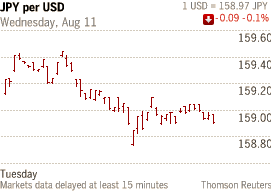
• Currencies. The yen has since bounced off its low of Y84.79, and is now up 0.1 per cent at Y85.38. Considerations such as haven buying for the dollar, and the risk of Japanese intervention in the market, have kept the currency from rising further.
The euro is down 2.3 per cent at $1.2870, its steepest one-day drop since January 2009. It has given up all its gains following the well-received bank stress tests. The yen is surging 2.4 per cent against the euro to Y109.89.
The pound was hard-hit following a jobs report in which the
decline in jobless claims slowed, and the Bank of England’s inflation report. Sterling is down 1.2 per cent, at $1.5665, after falling more than 1 per cent in the previous session.
The New Zealand dollar is off 1.2 per cent against the yen and the Australian dollar is down by 1.7 per cent against the US dollar. Both currencies closely track commodities and interest rates, which rise with growth hopes.
• Debt. The German 10-year Bund was the sharpest mover, with the yield falling 11 basis points to 2.43 per cent, a new record low.
Japanese 10-year yields fell 2 basis points to 0.999 per cent.
The yield on the US 10-year Treasuries is down 7 basis points to 2.69 per cent, off its lowest point since February 2009 hit earlier in the session. Five-year bonds, 7-year, and 2-year bonds also dipped to record-low yields, though they had recovered slightly as the session wore on.
Gilt yields also fell sharply, with 10-year bonds down 11bp to yield 3.14 per cent, their lowest since April 2009 following the Bank’s dovish outlook. An auction on Tuesday saw long-dated gilts pricing at below-market yields, though not strongly in demand by investors.
• Commodities. Benchmark crude oil is falling further past $80 a barrel, now at $77.51, down 3.4 per cent.
Gold, in one of the few signs of reassurance, is down just 0.5 per cent at $1,199 an ounce. Bullion interests investors as the risk of monetary inflation rises and the Fed’s relatively cautious move has evidently not sparked a change in fears of either inflation or deflation.
However, traders cautioned that big moves in gold may be muted by liquidations that raised cash for investors fleeing risk.
Follow the Global Market Overview on Twitter @telisdemos 


